
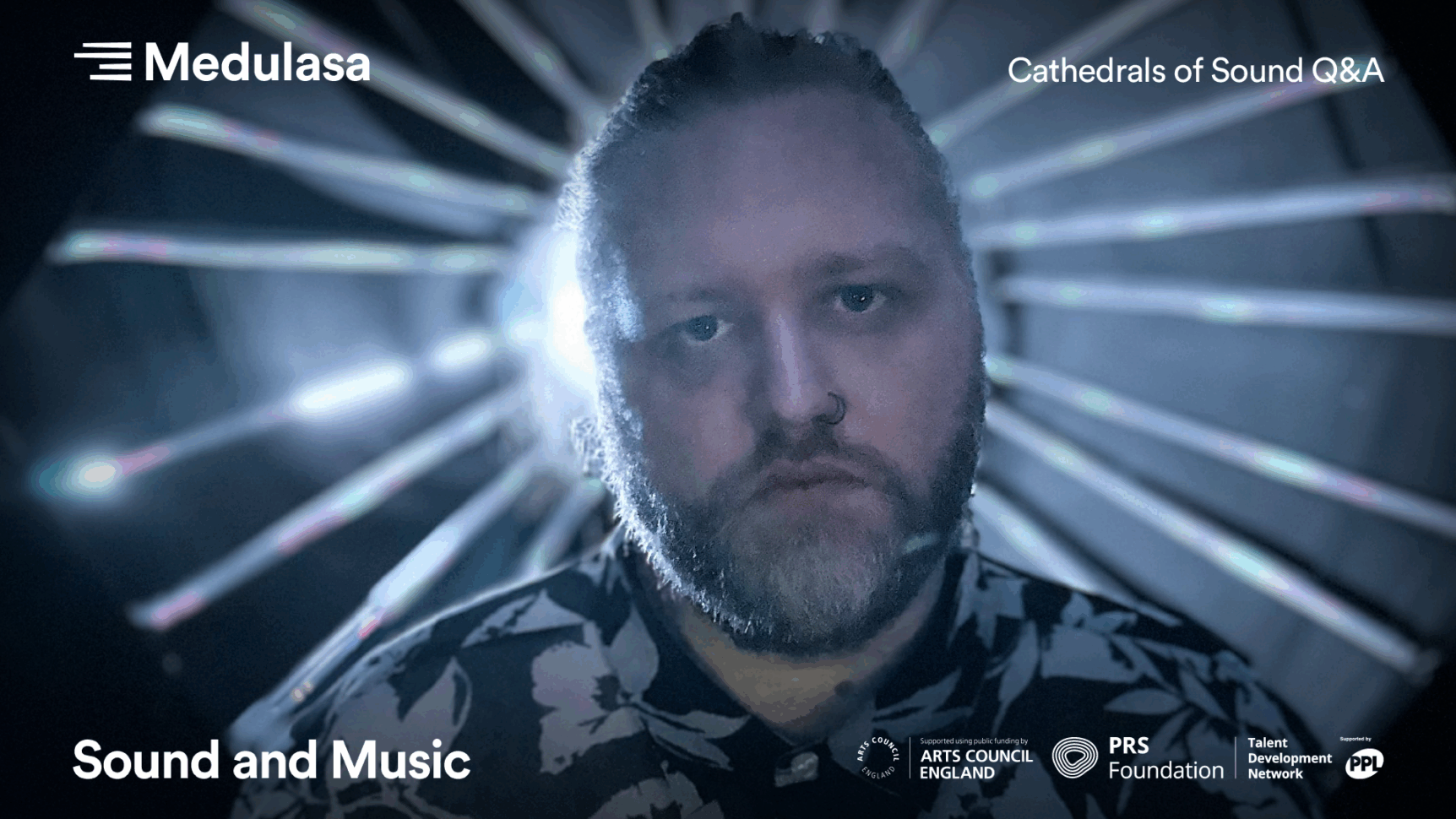





We’re excited to share Cathedrals of Sound: Remaking the Gothic — the official In Motion 2024 outcome by electronic music artist Medulasa. This public video series reimagines the Gothic in music from a contemporary electronic perspective, while documenting the creation of a new album (and, ambitiously, a new sub-genre) with live audience feedback.
The series explores the history, philosophy and musicality of the Gothic alongside Medulasa’s own practice as a composer and “permagoth” music nerd — building a fresh iteration of the Gothic in music from the ground up.
Each episode premieres on twitch.tv/medulasa every 2nd Friday of the month at 8pm UK time and again at 8pm US EST, followed by a live Q&A and work-in-progress workshop where the audience can actively influence how the record takes shape.
Medulasa is the main project of Bunny Kay-Traynor, a working-class composer, producer, DJ and audio engineer based in Wigan, Greater Manchester. They studied music composition and theory at Lancaster University as a way to rebel against their very punk parents, completing an MA in the process. After a long fallow period involving the founding of a record label, Bunny began making music again as Medulasa, blending influences from gabber and post-metal through to ambient and trance, all refracted through the lens of deconstructed club — a toxic, volatile mix that, in their own words, “threatens to kill the artist.”
Origins and artistic intent
What first drew you to exploring the Gothic through sound, and how did that evolve into the idea for a public-facing video series like Cathedrals of Sound? Was there a specific moment, text, or sound that catalysed the project?
I’m a second-generation goth, so I’ve always had a taste for the gothic, musically-speaking, but I’d felt recently that there had been a trend towards creating otherworldly music that had many hallmarks of the Gothic. It wasn’t generally being described as Gothic, only that people were using terms like “weird” and “eerie” and “uncanny”, and both with creators and journalists, it wasn’t music that was being geared towards a redefinition of what the Gothic-in-music is and can be at this moment in time. Noticing that, and wanting to create more of a space for the Gothic in a more contemporary context, provided the original impetus for the project.
It evolved into the video series by sheer dint of the fact that a lot of my work has traditionally been research-heavy, and this particular project needed people on board for it. The ambition is to leave both a rationale and blueprint of this new manifestation of the Gothic-in-music for others to follow, either to make their own iterations of the Gothic, or to use the methodology to create something else using the approach I’ve taken. A flag staked down in musical territory that proudly states its own gothic influence, and to offer a potential new path forward for the Gothic in music as a whole.
The title Cathedrals of Sound is evocative—how does the idea of sacred architecture or structure relate to your compositional practice and the Gothic more broadly?
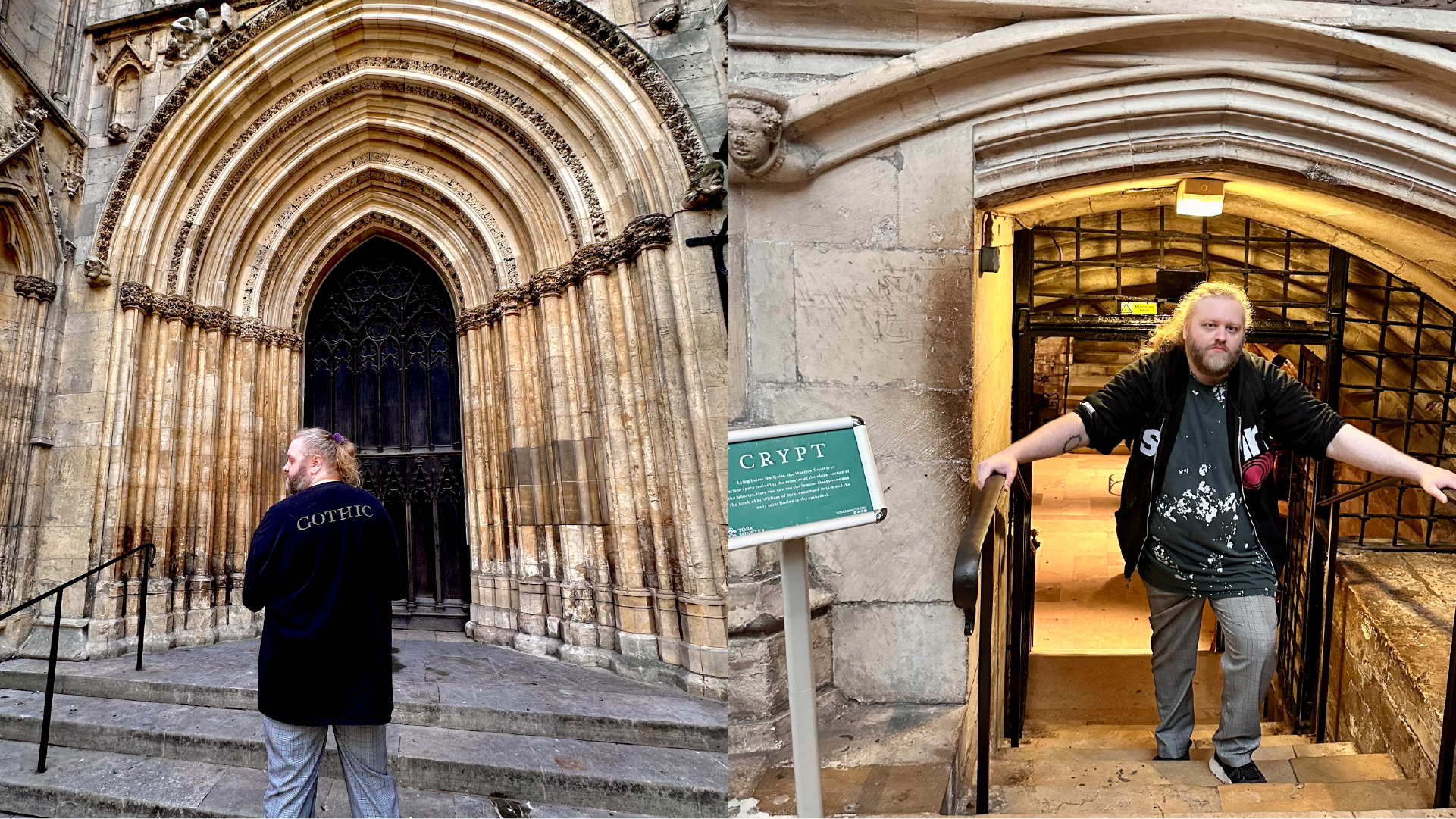
As a hangover from my days studying the works of Igor Stravinsky and other modernist composers – particularly Iannis Xenakis – at university, I tend to think about music in architectonic terms in general, but the inspiration came from an obsession with ecclesiastical architectural forms from my childhood. I grew up in a house in the direct shadow of an old church, its courtyard was my playground, and its inner walls seemed forbidden and mysterious growing up in an atheist household. It created a desire for the unseen, mysterious and beautifully-proportioned structures that it represented, leading to a later obsession with cathedral construction. The highly engineered sense of awe as you enter these spaces has been a goal of mine to reach in music: that sense of scale, of otherness, of craft.
“There is a nascent Gothic waiting to be born. In that process, I’m happy to be one of the midwives.”
— Medulasa
Compositional process and materials
What does your process look like when “building” a new iteration of the Gothic in sound? Are there certain instruments, techniques, or sound design methods you gravitate toward?
There’s a complex answer to this, and part of it is covered by the second video of Cathedrals of Sound! Essentially it’s a combination of: what’s worked before in other versions of the Gothic, a little theory-crafting as to how to more directly translate some of the base ideas of the Gothic into sound, and some are simply ideas I think may or may not work well in this context. The main concern in the music of the Gothic is one of timbre, particularly creating a sense – or multiple senses – of space through reverb. Some of the academics I read during the research period of the project emphasised the use of ancient or otherworldly instruments, for example, or avant-garde or advanced studio techniques to produce eerie sounds.
How are you translating complex ideas—like abjection, body horror, or the uncanny—into sound? Are there particular theoretical or cultural references that guide this process?
As a framework I’m using Mark Fisher’s wonderful little work The Weird and the Eerie, together with work by the academic Isabella van Elferen to guide the process of translating the uncanny into sound. Abjection and body horror are both a little more and less straightforward. I was keen at the beginning of the project to avoid comparison with cinematic works of body horror for inspiration, thinking it would inevitably tie the music down to a set of visual signifiers, which I think would miss the rich vein of phenomenological affect that pure music is able to produce as the most abstract of all the artforms. Ultimately, some of these sonic referents will be as straightforward as uncomfortably bodily sounds and sound design, and some will basically be vibes-based.
Reimagining the Gothic
What do you hear as the sonic traits of the Gothic, historically or culturally—and how are you rethinking or reformulating them in your own work?
How does your “new Gothic” differ from its predecessors?
The obvious sonic traits I have to use include minor keys and modes, descending melodies, a frankly horrifying amount of reverb, ancient or strange instruments (church organs, an unnameable instrument circling in the distance). Culturally, though, a lot of the traits of what we think of as “gothic” in music come from gothic rock – The Cure, Siouxsie and the Banshees, The Sisters of Mercy etc. And while that sound is still spiritually home to me (once a goth, always a goth), that sound is still very much tied to rock music. Coming from the more strange, danceable electronic music space that I’ve traditionally made music in – itself in a lineage of industrial music, which shares roots with gothic rock – these hallmarks of the gothic need updating for the modern musical context in which rock music is, by and large, a legacy genre, sonically speaking.
Why do you think the Gothic still matters—or matters again—in 2025? Do you see it responding to something specific in the current cultural or political climate?
There has been a resurgence, culturally, of gothic ideas across various musical spectrums; from the gothic, doom-laden pop music of Ethel Cain through to the strange forms of post-club music coming from the scene around Manchester’s White Hotel, through to post-punk and goth artists having trending songs on TikTok. Personally speaking, I think the sense of otherworldiness of this music is a refreshing change of pace for a lot of people in the hyperreal moment we exist in. Part escapism, part vibe curation, part storytelling.
“A flag staked down in musical territory that proudly states its own gothic influence, and to offer a potential new path forward for the Gothic in music as a whole.”
— Medulasa
Audience collaboration and live-streaming
Audience feedback plays a central role in the project. Why was it important to include that level of interactivity, and how has it shaped the music so far?
Audience feedback felt integral to me at the start of the project as a course-correction as a composer trying to do something that could essentially be passed on, methodologically. To an extent it was almost like trying to set up my own peer review process; laying out my ideas, testing which work and which are not quite fitting the thesis, getting redirection from interested parties. It also served as a way to get people involved in the idea of remaking and redefining the Gothic at all. My intention was to make this an ongoing conscious redefinition of the Gothic-in-music and have the project be replicable for other artists, so having others involved in the making of the record and everything that led up to it was essential.
So far, the main way that audience feedback has shaped the music so far is that people have kept me from just delving into pure Nine Inch Nails’ “The Downward Spiral” worship!
How do you approach the vulnerability of sharing unfinished, experimental work live? What has surprised you about the feedback sessions so far?
Honestly, this has been the hardest part of the project for me. I’m a perfectionist by nature and generally have always loved to show the final results to people as if presenting a magic trick. Hearing works in progress had been the exclusive realm of my partner and my best friend only. Opening myself up to showing half-finished, half-dreamed bits of work was both terrifying and heart-wrenching. But what gave me courage was that David Bowie quote about wading out into the waters where your feet don’t quite touch the bottom anymore, and that being the ideal place to make something interesting from. Going to the place that felt uncomfortable, and then committing to working from that point has really helped open me up, and for that I can thank In Motion. I wouldn’t have had the courage to do that without the support from Sound and Music.
What’s surprised me is people are so on board and understanding of both how and why everything is being constructed as it is. It seems to be partly intuitive from hearing the music, which shows that I’m doing something right!
© Medulasa
Structure and series development
The episodes follow a clear arc—from introduction, to philosophical deep dive, to compositional reformulation. How did you shape that narrative? What do you hope the audience experiences across the series?
I based the structure on how one would structure an academic thesis, but also it’s how I structured the project as a whole. I wanted to take people on a journey with me – as much as I could – through this project, to see how and why I’m doing it.
I also think that in an era where A.I. music gets presented as a finished product alongside every other (human) artists’ music that has ten thousand times more meaning and craft involved, one of the ways we as artists can really push our value is by actively showing how our work is more involved, more carefully thought out, more interesting from foundation to end product, than generative A.I. is capable of.
“The highly engineered sense of awe as you enter these spaces has been a goal of mine to reach in music: that sense of scale, of otherness, of craft.”
— Medulasa
Looking forward
What might this project evolve into after the final episode? Are you envisioning a release, performance, or something else?
The project was always supposed to culminate in a release – a proof-of-concept, a jumping-off point. Originally when I applied to be on In Motion, it was to create something that I could fully bring my skills to bear on, something that my dad told me to do just before he passed away. That wish of his, and the musicality he fostered in me, has carried me through this entire process, even through a difficult hearing issue that pushed back the project several months.
What’s been the most unexpected thing you’ve discovered about the Gothic—or yourself—through making Cathedrals of Sound?
In many ways, I didn’t expect people to be so on board with it, or so understanding of its aims. It’s been more than a little bit of a confidence boost to know that my initial instincts seemed correct, and that there is a nascent Gothic waiting to be born. In that process, I’m happy to be one of the midwives.
Catch up on previous episodes on YouTube
Follow Medulasa on Instagram
Visit Medulasa’s Profile