
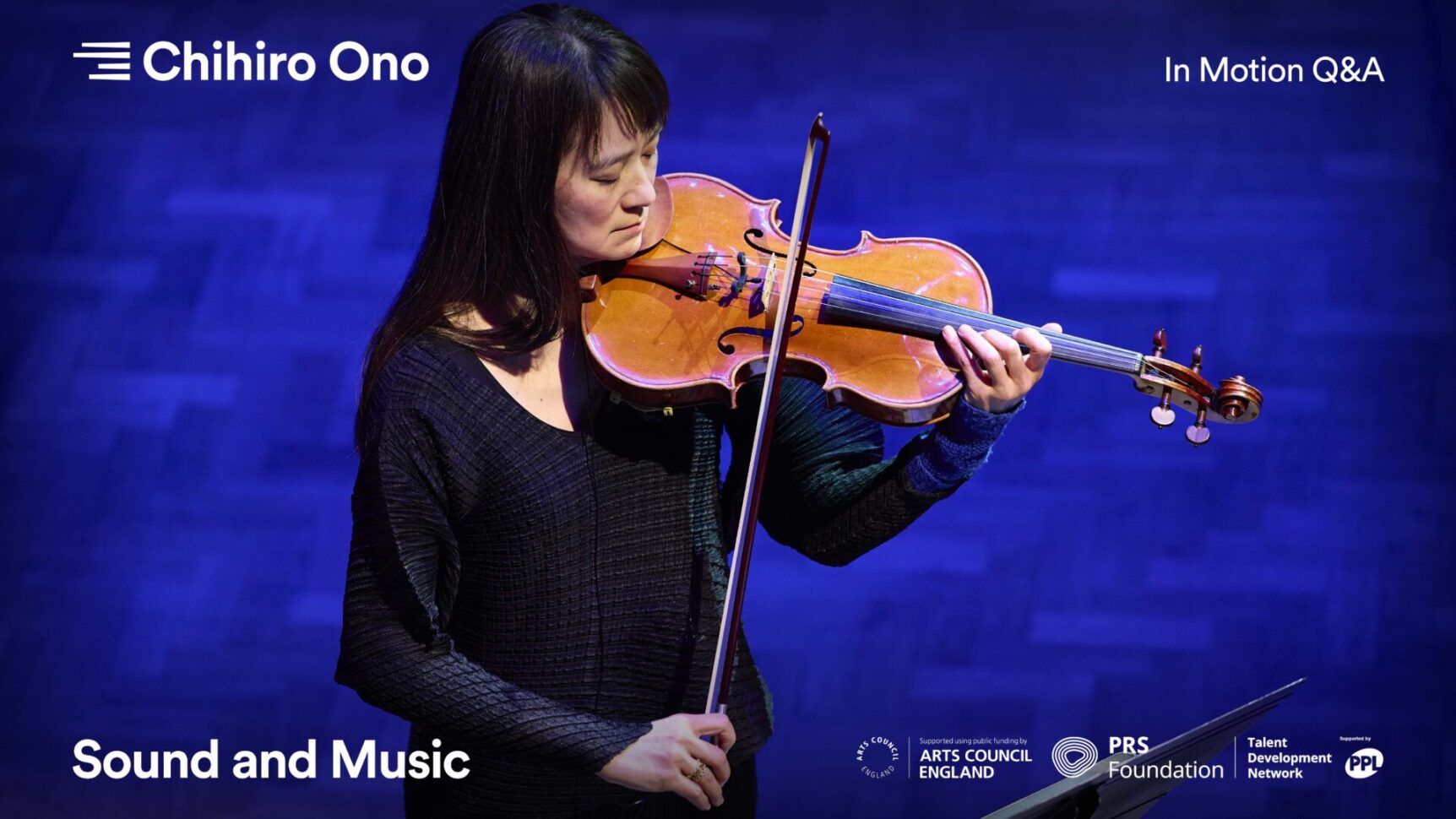





We’re excited to share this new Q&A with Chihiro Ono and our Head of External Engagement, Finn Grant, focusing on the ideas, research and processes behind Chihiro Ono’s new album.
A Japanese-born, London-based violinist and violist, Chihiro has built a distinctly collaborative career performing internationally with leading ensembles and composers, and in recent years has increasingly carved out space as a sound artist across live performance, theatre, radio and film.
Developed through In Motion 2024, the album documents a period in which Chihiro deep-dived into ethnology, folklore, science, philosophy and sound to begin shaping a personal compositional voice alongside her long-established life as a performer. Released in October 2025, Chihiro Ono with In Motion: Sound and Music is now available to purchase and stream, offering listeners an intimate first glimpse into this evolving sound world.
Alongside the release, Chihiro Ono will soon perform works developed on In Motion 2024 as part of the concert Apartment House perform new music from Japan at Café OTO, bringing these ideas off the page and into a live, collaborative context.
“The journey of developing this work helped me to deeply and fearlessly dive into my curiosity.
It gave me the opportunity to research on things that I needed to gain the knowledges, chance to challenge my capacity to shape my imaginative world into reality, and courage to seek my philosophy on creating music.”
— Chihiro Ono
Origins and artistic identity
How has the journey of developing this body of work helped you to recognise yourself as a ‘composer’?
The journey of developing this work helped me to deeply and fearlessly dive into my curiosity. It gave me opportunity to research on things that I needed to gain the knowledge and chance to challenge my capacity to shape my imaginative world into reality, and courage to seek my philosophy on creating music, e.g. what is music to humans, why humans need it and keep making it, and what does “own voice” mean to composers. This process gave me a first solid step towards to my confidence on making music with my voice / style.
The album is only showing a part of my voice and only a tiny result from the incredible life changing journeys. It is like a mini test chocolate box you discover and taste for the first time.
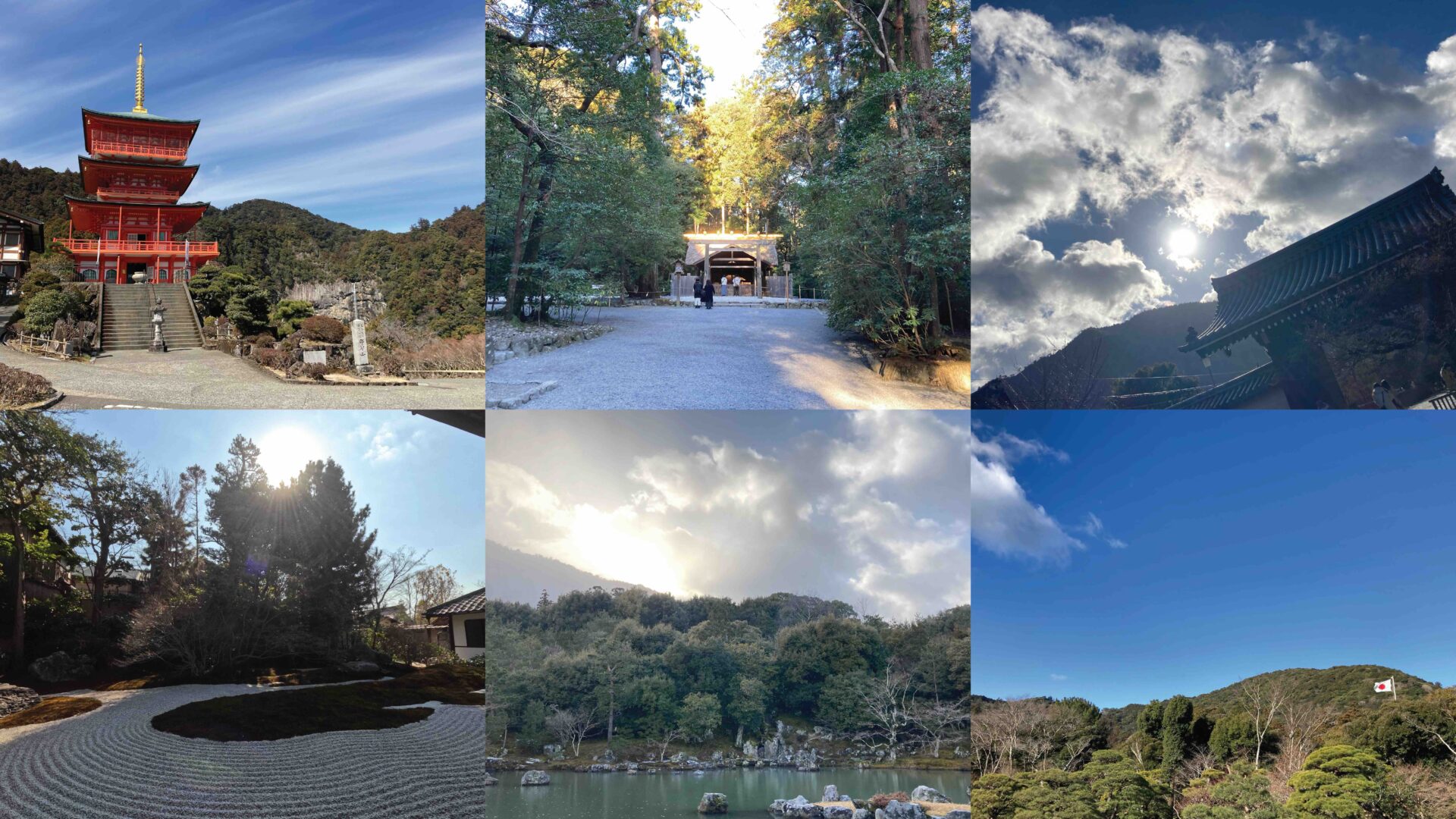
The process © Chihiro Ono
After this journey, I finally feel the confidence to say “I also compose” without hesitation, because I have touched the roots of my voice. From now on I just need to water it, take care, and make sure it grows into the open sky.
Performing arts with music, with violin and viola, has been my identity and main profession since the age of 8 months. That won’t change, at least for now. With In Motion I have gained a new starting-point tool to do music in my life. Now I have two (still) unbalanced tools: performer (100) and composer (5!?), but I have not gained any skill or solution to live a life with them yet. My challenge from now on is that how to keep both, doing music as a professional violinist / violist, and making music as (also) a professional composer.
“The album is only showing a part of my voice and only a tiny result from the incredible life changing journeys. It is like a mini test chocolate box you discover and taste for the first time.”
Heritage, training and perspective
How does the work reflect and explore the contrasting influences of your Japanese heritage and your Western training?
Heritage and training is something humans value as disciplines in our lives. It keeps humans and arts alive with faith. Personally, I do not feel any “contrasting influences” in my Japanese heritage and my Western training. There is no “contrast” on our arts.
For me the basic idea of humans making and doing art of music is coming from the same root as being willing to communicate with sounds and emotions, directly without any language barriers to others and self. Languages and words are what sets us apart from each other. It is a useful tool to talk things out, but it does not share the core part of anything.
Understanding the origins and fundamentals of things is human heritage, and I do train myself to digest them and re-do it for others in real life, through music.
Reflect and Explore is something that you / listeners experience from a personal perspective. Receiving the experience has to be free from any ideas. I do not want to tell you how to receive the experience with my piece. Instead, what I can tell you is that I am born and raised in Japan, living in London since 2000, have been building a life with violin, viola and Western music, and just started gradually discovering my roots (Japanese tradition) through being professional in arts and music. I believe you can hear some of my life journey and experience from this work here now.
Language is not enough for me to explain what I think, see and feel. I can only say that we are standing at a place to explore the influences and reflections of human heritages through my voice shaped by the art of music. The rest is your perspective!
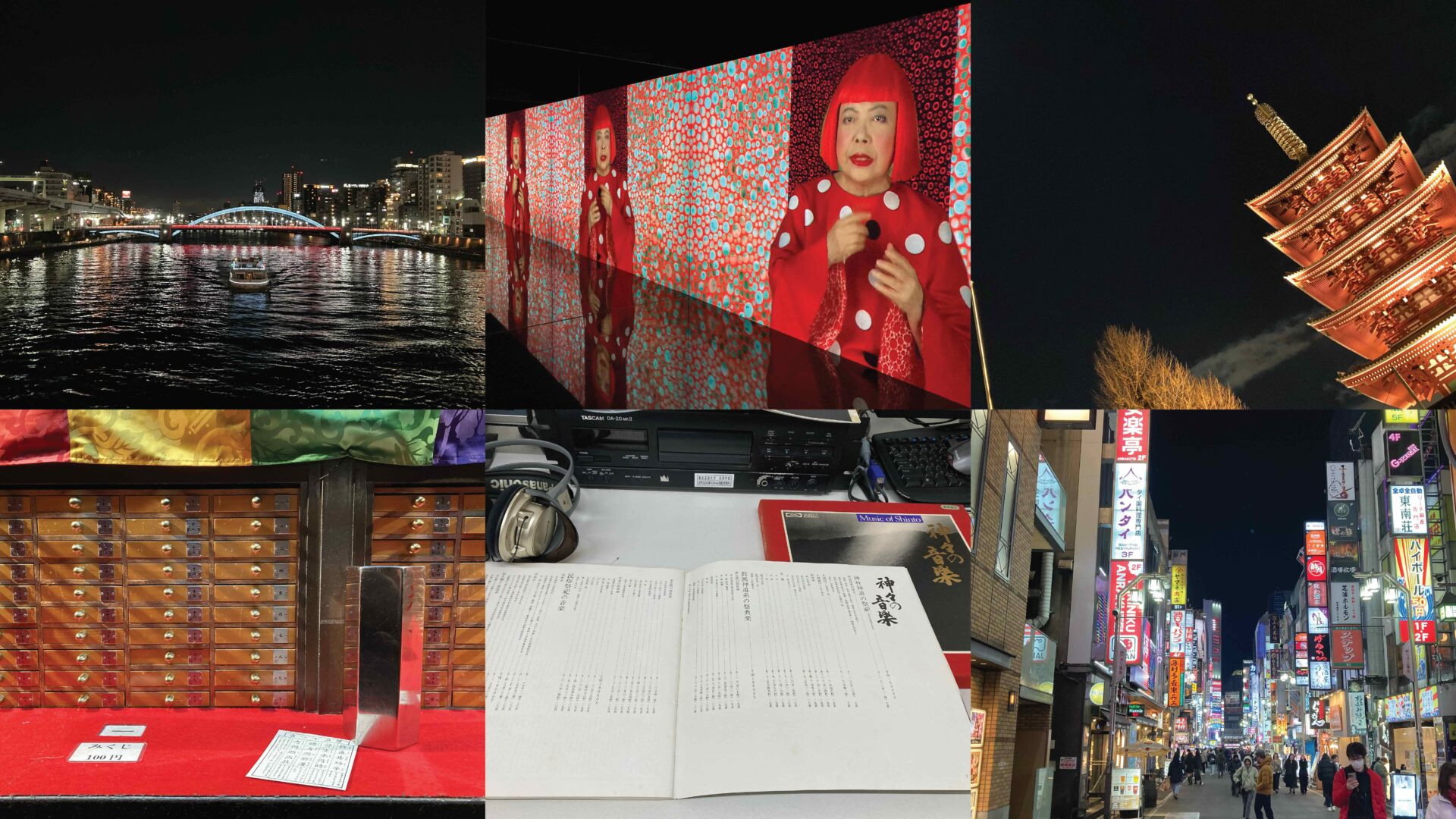
The process © Chihiro Ono
“Language is not enough for me to explain what I think, see and feel.
I can only say that we are standing at a place to explore the influences and reflections of human heritages through my voice shaped by the art of music.
The rest is your perspective!”
Inspiration and creative process
What other inspirations informed the work?
Every single sound (vibrations), colours and shapes in my life, the histories of living creatures, the reality of this world with human-created cultures (e.g. religions, traditions, arts, philosophy, divisions), global concerns on the environment and surroundings with the reality of our everyday life, and the Science of Sounds, Colours and Shapes, e.g. how it works on / with our whole body, senses and the nature and universe (cosmos) – these are all my sources and inspirations. I try to digest these through my perspective and capacity, and express them into audible art forms to share with like-minded creators / performers and listeners who are brave to question the questions, be faithful to show respect, and be bold to break the regularity and ordinality of the normalities. I believe these sources and inspirations will continue to grow and shape my existence with arts till the last moment of my life.
Can you talk us through your creative process in developing this body of work?
My notebook on this creative process started with a quotation of David Bowie’s interviews that randomly caught my eye on floating-instagram. “Always remember that the reason you initially started working was that there was something inside yourself that you felt that if you could manifest in some way, you would understand more about and how you coexist with the rest of society. I think it is terribly dangerous for an artist to fulfil other people’s expectations. I think they generally produce their worst work when they do that. If you feel safe in the area you are working in, you’re not working in the right area. Always go a little further into the water than you feel you are capable of being in. Go a little bit out of your depth. And when you don’t feel that your feet are quite touching the bottom, you’re just about in the right place to do something exciting.”
I have started this journey of mine with my usual habit – questioning myself many philosophical questions, e.g. views on life and death, what am I in the arts, why I do music and play violin, what do I mean by “my voice” in composition and why I need to search for it, what is music to me and to others, and so on. During In Motion, everyday my arty brain woke up between 4 and 5am and was active on the questions and creating ideas the whole day. I have read many, many books to research and discover my answers on the topics.
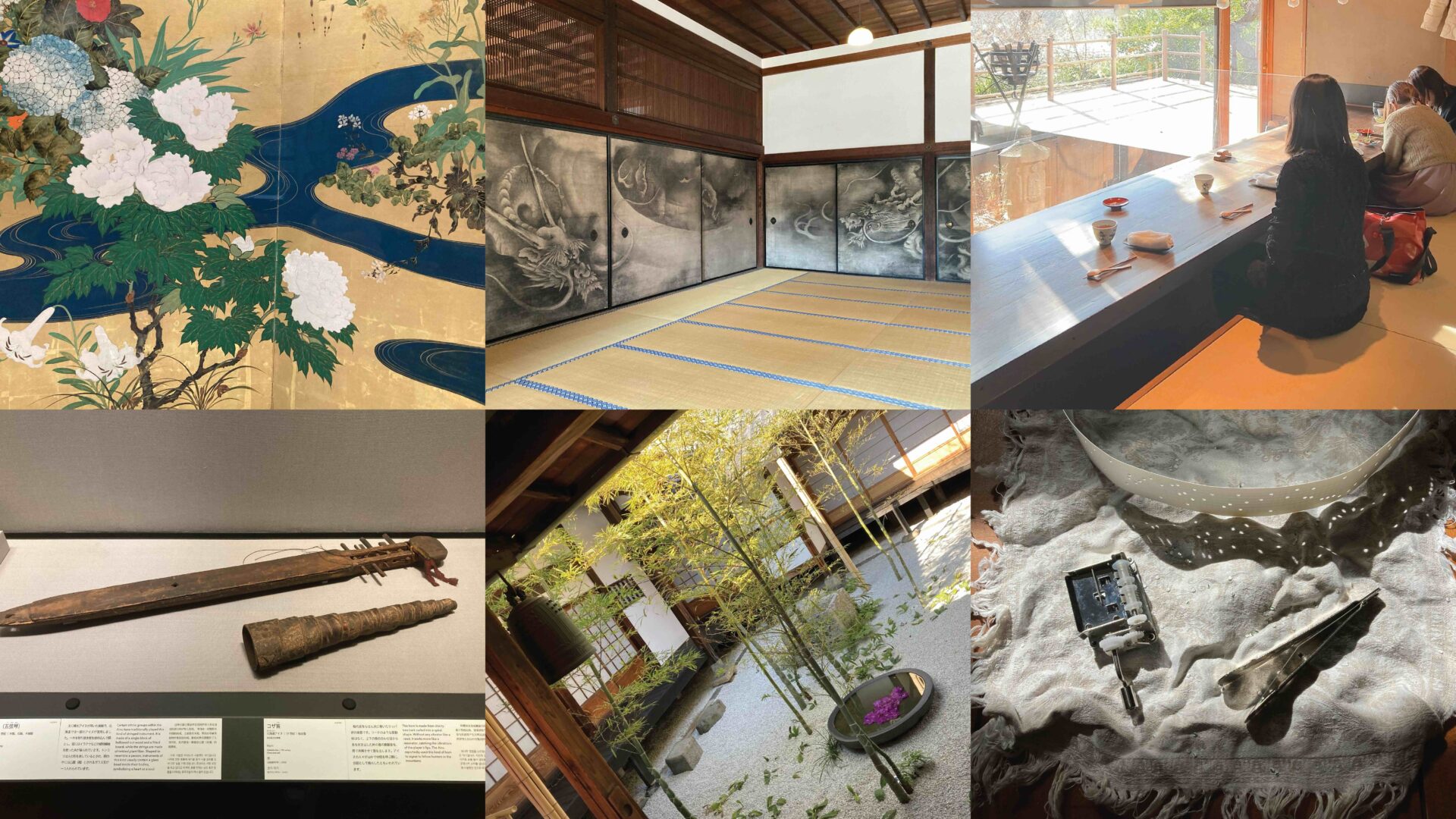
The process © Chihiro Ono
This led into a deep research on studies of Ethnology and Folklore studies, and philosophy of things and existences of things of Japan. I went to have workshops with women Joruri players and with an Ainu academic researcher, went to archives / libraries to search and listened to the historical books and recordings, asked the academic researchers’ views on their specialised folklore studies and the roots of Japanese and Ainu. I studied about systems of musical structure and method in folklore, religions and traditions, and the Sciences on sounds, e.g. microtones, how musical scale are born, music with brain, vibrations on sounds etc. On top of these, I have added on my long-term fascination (but very little knowledge) of mathematics and physics, e.g. astronomy, dynamical systems, chaos theory, string theory, and I have used my life-long professional force on music (baroque, classical, romantic, contemporary, new and experimental music) skills, knowledges and methods, AND my life-long-personal-senses on shapes, colours and textures on sounds with music.
This research as vast as like the universe is shaping my compositional voice now, which you hear a little part of it in the tiny result in the tiny album.
Now, I have to talk honestly about the dark side of this programme here. To be able to make things happen within this demanding programme, I needed to reduce significantly my professional works as a violinist / violist, to make a good amount of time for this programme. As the result, I have gained many, many knowledges as a wellspring of creativity for my future (yet uncertain) as a composer, but in reality my financial security noticeably weakened to live life with my life profession (violinist).
“This research as vast as like the universe is shaping my compositional voice now, which you hear a little part of it in the tiny result in the tiny album.”
Breaking new ground
What was new for you in developing this work? How is the work breaking new ground for you artistically?
Having time and reason to deep-dive into the intense questions and research on my compositional voice, shaping it all into an audible musical form, and discovering the (another hard core) world of composers.
It did break my wall (excuses) to challenge my capacity to discover the other side of my creative abilities, and to be brave to speak “loudly” my inner voice of imaginative sound-worlds out into the real world.
Music and the human experience
You have always used music as a tool to explore the human experience – how does that manifest in this new work?
…I do not know how to it “manifests”… Is it something I have to tell you in words or languages? Is it not shown in the way I live, my existence, or how I compose my sound world??
Music is a tool to explore and express oneself first, and with others next. It always starts with inward experience and expression, which, at least I think, we technically cannot explain properly what it (music / art) does to us…
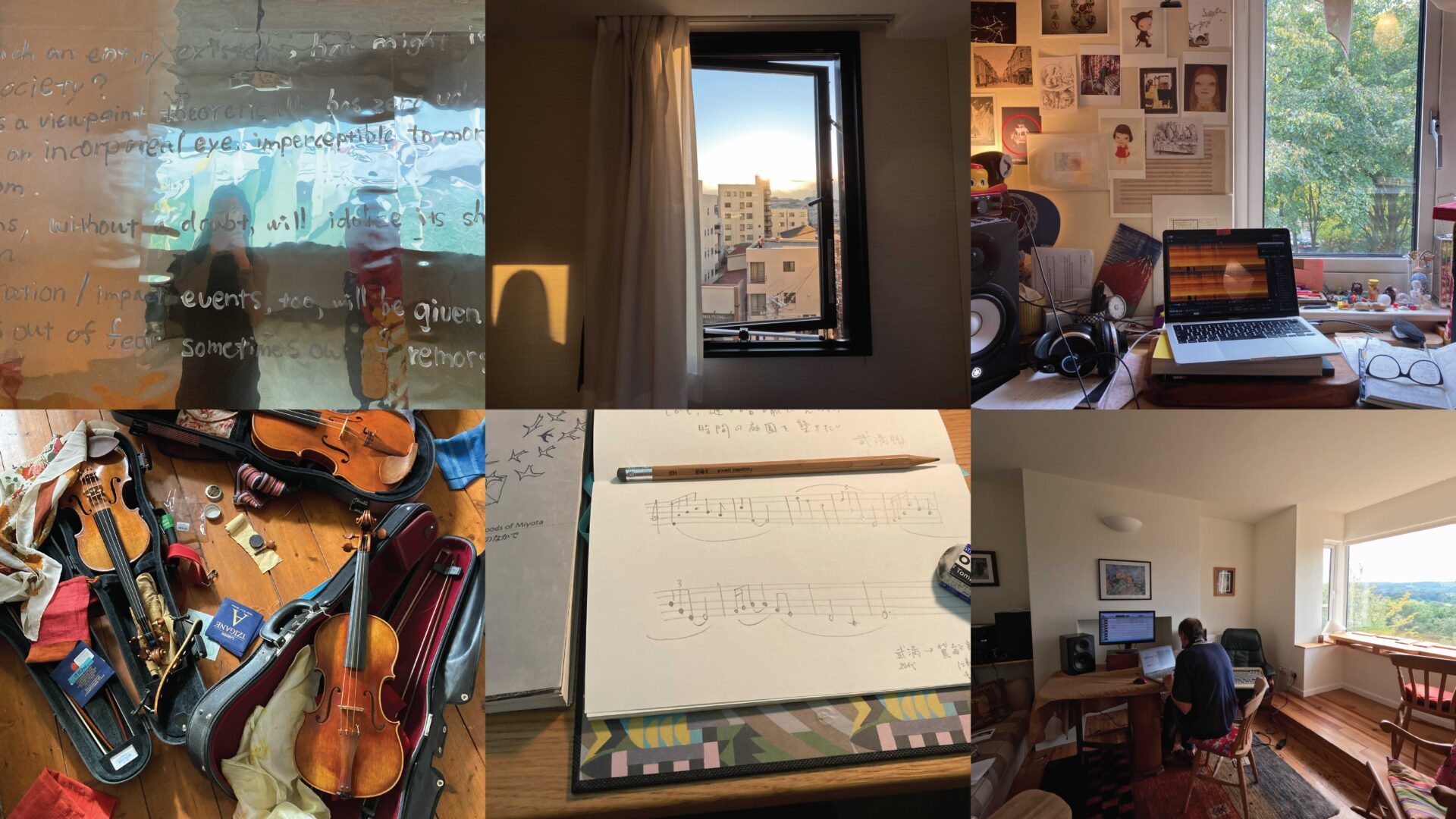
The process © Chihiro Ono
Manifest – for me that can mean fixing the way of thinking or experiencing of things, which is against my will and aim. Manifesting something about art feels like forcing you to feel / experience it in a particular way. I would like you / the receiver to be open as much as possible to see things for yourself. Arts / music reflect our own selves. In the other words, how others see things is not my job to fix or indicate how it should happen.
What I can answer here is that, as it is written all in the “creative process”, this new work is my (small) result of exploring the documented human achievements (e.g. music, science, beliefs), and I would rather like to ask you back – what manifests for you in my new piece? I am more curious to know what you see through the experience with my sound world.
“Music is a tool to explore and express oneself first, and with others next… I would like you / the receiver to be open as much as possible to see things for yourself.”
Upcoming performance
Apartment House perform new music from Japan, featuring Chihiro Ono
Date: Wednesday 18 February 2026, 7.30pm
© Apartment House
Apartment House performs new music from Japan for the first time in the UK, music by Atsushi Reizen, Chihiro Ono (developed through In Motion 2024), Leo Okagawa, Taizo Hida, Yuji Takahashi, alongside classic works by Yoko Ono and Yasunao Tone. Wholesome beauty, strangeness, noise, faraway sounds and nearby scrunch.
Apartment House performers are Mira Benjamin, Chihiro Ono violin, Bridget Carey viola and Anton Lukoszevieze cello.
The album
Chihiro Ono’s new album — emerging from her work on In Motion 2024 — remains available to purchase and stream, offering a way to encounter this new compositional voice before or after experiencing it live.
Created on Sound and Music’s In Motion programme.
In Motion is made possible with the generous support of Arts Council England, PRS Foundation, Jerwood Foundation, Garrick Club Charitable Trust, Michael Guest Charitable Trust, Marchus Trust and Creative Scotland.
Composing, Performing, Recording, Mixing, Editing and Mastering by Chihiro Ono.
Recording and Mentoring on Sounds by Simon Reynell.
Visual scores
The project also extends into visual and graphic work: cartoon scores, colour and shape studies and animated interpretations of pieces from the album. These videos give another way into Chihiro’s compositional thinking, where drawing, movement and sound are tightly interwoven.
Drawing, Performing, Video, Montage and Mastering by Chihiro Ono.
Cartoon score / Do Music
Cartoon score / with Violin
Colour and Shape study with Visual Action
a Night Dream with Cartoons
Listen, follow and find out more
Follow Chihiro Ono on Instagram
Stream / buy Chihiro Ono with In Motion: Sound and Music
Event details: Apartment House perform new music from Japan
Read Chihiro Ono’s first In Motion 2024 Q&A